The most popular and comprehensive Open Source ECM platform
Let us know more


Carbon Capture, or Carbon Sequestration, is the removal of CO2 gases from the earth’s atmosphere in order to mitigate or reverse climate change. Some researchers say that without carbon capture, the chances of stopping climate change are slim.
Right now the technology for carbon capture already exists, but there are a number of problems with the existing techniques. It is expensive in terms of both dollars and the energy that’s required to do the capture. Once the gas is removed we need to do something with it.
One idea that’s been popular for a long time is storage in the ocean. The CO2 is transported to great depths in the ocean where high pressure causes the CO2 to form carbon dioxide hydrate which is heavier than water and will then sink to the floor of the ocean. The efficiency of this process however is low. Others have also expressed concerns about the affect on ocean life and the oceans themselves.
That’s just one idea for CO2 storage (CCS == Carbon Capture and Storage). But not only is capture and storage of CO2 expensive, it needs to be done at enormous volumes. By some estimates, the volume of CO2 needed to be removed to positively affect global warming is about two to four times the volume of all the oil and gas currently used today.
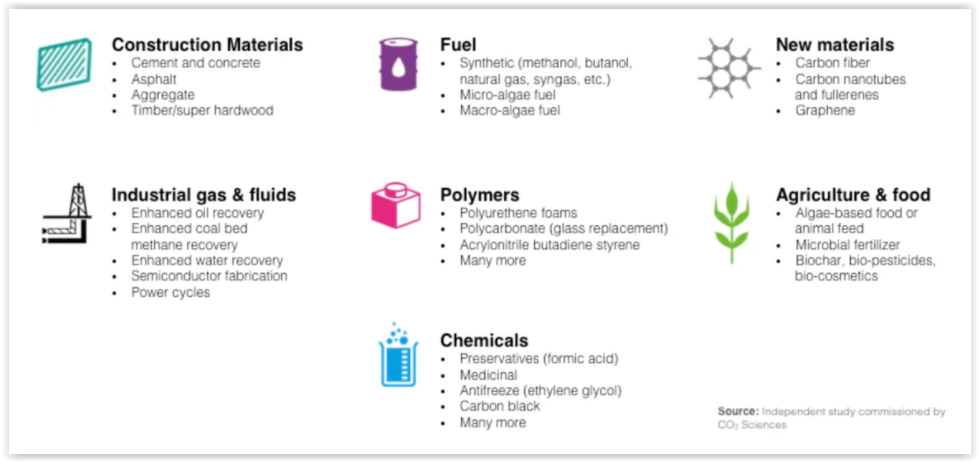
Rather than storage, a better strategy would be to somehow be able to use the CO2. That approach to the problem is called carbon capture and utilization (CCU). CO2 is used for fertilizers and for food and beverages. It can also be used as a hardener in concrete.
Aramco is one company trying to get involved in the CCU industry. Their literature says that “capturing carbon has been used for decades as a way to help improve the quality of natural gas, but by pioneering new technologies we can now remove and sequester CO2 indefinitely. Moreover, we can now add value to what has always been considered a waste product, by turning CO2 into marketable industrial and commercial products.”