
The most popular and comprehensive Open Source ECM platform
Let us know more


The Internet of Things (IoT) refers to a worldwide ecosystem of physical objects that are able to communicate information across the internet. Central to the concept are smart objects and machine-to-machine communication. The term ‘Internet of Things’ was first coined in 1999 by Kevin Ashton at MIT, but it wasn’t until relatively recently that interest in the Internet of Things has grown. Google Trends shows sometime around 2013 interest in the Internet of Things really began to show rapid growth.
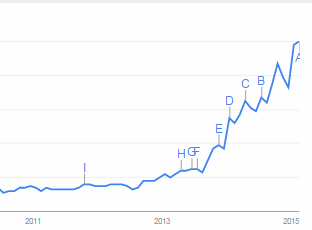
Google Trends for “Internet of Things” |
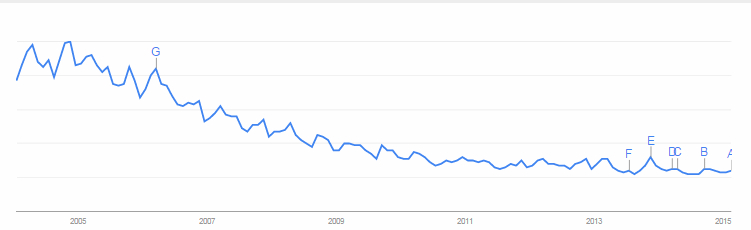 Google Trends for “RFID” |
 Kevin Ashton Coined the term “Internet of Things” in 1999 |
In order for objects to communicate they need to be equipped with something that can enable the communication. First-generation IoT was based on objects equipped with RFID tags. Ashton set up the Auto-ID center at MIT and promoted RFID as a way to tag and track the location of objects. Radio-frequency identification wasn’t new even then; it’s origin dates back to World War II. After a surge of interest from 2000-2005, interest in RFID had been waning, but recently RFID is poised to make a come back as a low-cost entry way for connecting IoT objects.
Chris Chang, CEO of Alien Technology, said that “the market hit bottom a couple of years ago, but it’s really good timing to talk about RFID again. We are seeing UHF RFID applied in many industries, and users are seeing payback from investments. We’re entering an era of steady and high growth. This is what the management team and investors believe. The Internet of things offers a huge chance for wealth creation. RFID gives identity to things, and so it is a natural part of the Internet of things. I see this as really good timing. The markets are maturing. Everyone is now talking about IoT, and the end users are really seeing the benefits.”
Interest in RFID has become so strong that 23 percent of all RFID tags ever sold were sold in 2013. In 2014 another 1.12 billion tags were sold.
Enu Waktola, vice president at Smartrac Technology, wrote that “the number and range of IoT applications that can be envisioned with RFID devices are simply tremendous. The inherent value of RFID lies in enabling ‘things’ to report data in real time for faster, quicker, more interactive decisions both at the industrial level and — increasingly — at the consumer level.”
“”


