
The most popular and comprehensive Open Source ECM platform
Let us know more


A webfeed is a low-bandwidth XML stream available on the network that can be easily consumed by custom or special webfeed reader applications. In a previous blog I discussed how webfeeds often form the raw data to support mashup applications and have the potential to support business communication within process workflows.
Examples of publicly available webfeeds can be found at Amazon’s A9.com search and Yahoo! Feeds. Webfeeds have many of the advantages of Web Services, but compared to Web Services, webfeeds are far easier to create and consume. Actually, if your definition of a Web Service is simply a URL-based data source, webfeeds could be considered as a special type of Web Service.
There are multiple formats for Webfeeds, but RSS 2.0 (Really Simple Syndication) has emerged as the most popular and best-supported format. Tools are becoming available that make data syndication via RSS even simpler. One example is freely downloadable product called RSSBus.
RSSBus is a framework of tools and services for easily creating and consuming RSS feed data. It is middleware that is billed as the “The Service Bus for the REST of us”. It includes an XML-based scripting language called RSBScript.
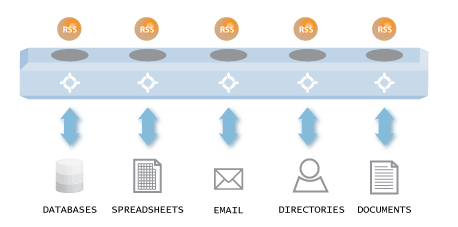
With RSSBus you can easily publish relational database queries, tables and view information, or information contained in spreadsheets and email. It’s a very effective way to publish raw data. One caveat is that RSSBus is only available in a Windows .NET 2.0 framework. Also note that Microsoft plans RSS integration capabilities as part of the upcoming Vista release.
Document publishing via RSS is an interesting application. Within a document management context, being able to publish a webfeed channel of a specific type of release document, or to receive notifications about document changes or deletions are useful applications of webfeeds.
But how secure are webfeeds? If you’re behind a firewall and the data is hosted inside, there may not be much to worry about. But for feeds exposed on the open Internet, more thought is needed. Very simple access control is achieved by restricting the webfeed URL to only those people who need access, a technique used by Flickr. But that kind of security policy is bound to keep you up nights if you are exposing any even remotely sensitive data.
HTTP Authentication can also be used to secure the webfeed publishing. But one problem is that while there are some webfeed readers that support HTTP Authentication, like NewsGator, there are a lot more, like the Google Reader, that don’t yet support it. Although if the consuming application is under your control, that may not be an issue. Another security option is to encrypt the data stream using SSL encryption.
Webfeeds, especially those using RSS 2.0 technology, are important tools for giving consumer and corporate users a way to better be able to control the consumption and presentation of data, but security is one area that needs to be thought through carefully before deploying this technology.


